Hair Loss Causes: Why Your Hair Is Falling Out and Where to Start


In this story ·

By Afsennah, Certified Advanced Trichologist · New version: November 20, 2026 · First published: January 10, 2025
It starts small. A few more hairs in the shower drain. A ponytail that feels a little lighter. Then one night you're under the bathroom light, tilting your head, checking your part from every angle.
I know that feeling, and I want you to know two things. First, hair loss is very common. Second, there's almost always a reason. Let's go through the most common hair loss causes, how to find yours, and where to start.
Key Takeaways
- ✓Losing about 50 to 100 hairs a day is normal.
- ✓The most common hair loss causes are stress, genetics, hormones, deficiencies and some scalp conditions.
- ✓Stress shedding usually shows up around 3 months after the trigger.
- ✓Breakage looks like hair loss, but it's not the same thing.
- ✓Finding your cause comes first, because the cause decides the treatment.
The short answer
The most common hair loss causes are stress or illness (telogen effluvium), genetics and hormones (androgenetic alopecia), postpartum changes, low iron or other nutrient deficiencies, thyroid problems, autoimmune conditions like alopecia areata, and tight hairstyles. Losing 50 to 100 hairs a day is normal. More than that, or a wider part, is worth looking into.
How Much Hair Loss Is Normal?
Losing about 50 to 100 hairs a day is completely normal. Your hair grows in cycles, and every day some hairs reach the end of their cycle and let go so new ones can grow.
On wash day, it can look like a lot more, because hairs that already let go get caught and come out together. That's normal too.
What's not normal: clumps that keep coming week after week, a part that's getting wider, bald patches, or a ponytail that's clearly thinner than a year ago.
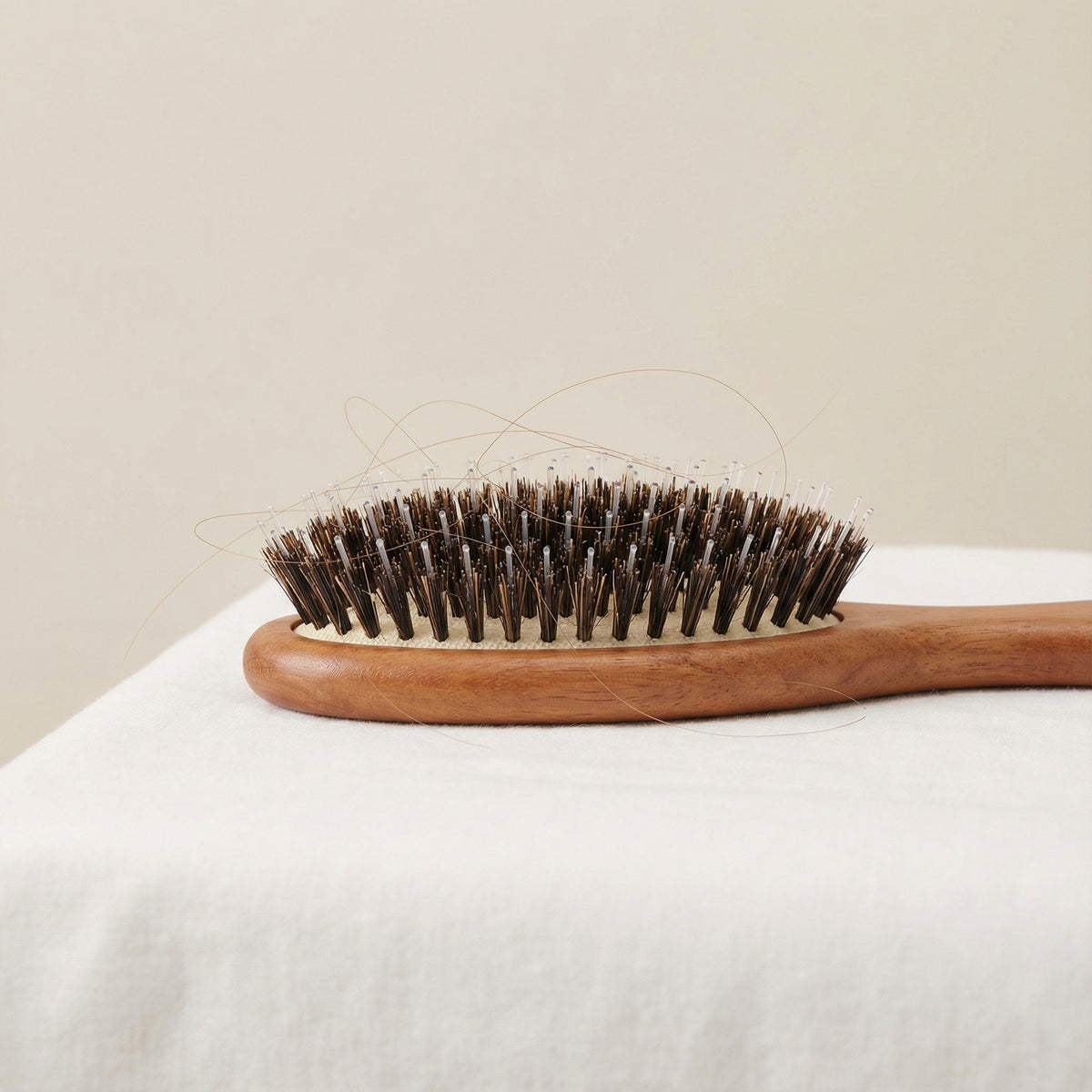
Read nextHair Growth Cycle: How Hair Growth Works, Phase by Phase →
The Most Common Hair Loss Causes
1Stress, illness or a big life event (telogen effluvium)
Fancy name, simple meaning: a shock to your body pushes many hairs into their resting phase at once. A high fever, surgery, a crash diet, a breakup or a very stressful period can all do it. The shedding usually starts around 3 months later, which is why people rarely connect the two. It's often temporary once the trigger is gone.
2Genetics and hormones (androgenetic alopecia)
This is the most common cause of long-term thinning in both women and men. Hair follicles slowly get smaller, so hairs grow finer and shorter. In women, it usually shows as a wider part. In men, it often starts at the temples or crown. It can't be cured, but it can be managed, and the earlier you start, the better.
3Postpartum hair loss
During pregnancy, high hormone levels keep more hairs in their growing phase. After birth, those hairs shed together, usually starting around 3 months postpartum. It's very common and usually temporary.
4Nutrient deficiencies
Low iron (ferritin) is one of the biggest hidden causes, especially in women. Low vitamin D, zinc and not eating enough protein can play a role too. Your hair is a non-essential tissue, so when your body runs low, hair is often the first thing it skips.
5Thyroid problems
Both an underactive and an overactive thyroid can cause diffuse shedding all over the head. A simple blood test checks this.
6Alopecia areata
An autoimmune condition where the immune system targets hair follicles, usually causing round, smooth bald patches. It needs a dermatologist.
7Tight hairstyles (traction alopecia)
Tight ponytails, braids, extensions and buns pull on the same follicles day after day. It often shows at the hairline and temples. Caught early, it's often reversible. Left too long, it can become permanent.
8Scalp conditions
An inflamed scalp isn't a happy place for hair to grow. Seborrheic dermatitis, psoriasis and other irritated scalp conditions can come with more shedding, and scratching makes it worse.
9Breakage (not true hair loss)
Heat, bleach, rough brushing and tight elastics can snap hairs along the length. It looks like hair loss in your brush, but the root is fine.
Trichologist tip
I've had androgenetic alopecia and alopecia areata since I was young, together with scalp eczema. So I know how it feels when every hair in the sink feels like an emergency. What helped me most was finding out why, because once you know the cause, you stop throwing random products at your head. That's still how I read every consultation: the cause decides the treatment.
Hair Loss Causes in Women vs. Men
In women, the most common causes are telogen effluvium, female pattern hair loss, postpartum shedding, low iron and thyroid changes. Hormonal shifts like stopping the pill, PCOS or menopause can also play a role.
In men, androgenetic alopecia is by far the most common cause, usually showing at the temples and crown. Stress shedding, deficiencies and scalp conditions affect men too.
How to Find Your Cause
- Do the bulb test. Look at a few shed hairs. A tiny white bulb at the end means it shed from the root. No bulb means it broke.
- Look at the pattern. All over? Think stress, deficiencies or thyroid. Wider part or crown? Think androgenetic alopecia. Round patches? Think alopecia areata. Hairline? Think tight styles.
- Look back 3 months. Illness, surgery, a baby, a diet, a stressful event?
- Ask your doctor for a blood test. Iron (ferritin), vitamin D, zinc and thyroid are a good start.
Read nextThe Hair Bulb Test: How to Check Your Own Hair Fall at Home →
Where to Start: Your Hair Loss Routine
1Find Your Cause and Stop It
This is step one, always. A routine can't outrun a deficiency, a too-tight ponytail or a thyroid problem. Treat the trigger with your doctor, then support your scalp.
2Wash With a Gentle Shampoo for Your Scalp
A clean, calm scalp is the base. Use a Custom Shampoo made for your scalp type (condition). Put some in your hand with a little water and emulsify it, so it spreads better on your scalp while you massage it in. Guys, there's a Custom Shampoo for Him too.

Afsennah pick
Custom Shampoo
Made for your scalp type. Free from sulfates, parabens, silicones and alcohols.
Shop now3Activate Your Hair Follicles With Deep Oiling
Let's wake those follicles up. Massage your scalp for five minutes a day, and start deep oiling, which is my favorite treatment. First the Microneedle Scalp Roller, 1 to 2 times a week on a clean scalp. Then the Custom Hair Growth Treatment on your scalp, and the Custom Hair Care Treatment on your lengths. Leave it on at least 4 hours before washing, or overnight, 2 to 3 times a week.

Different causes need different ingredients. Stress shedding needs different support than androgenetic alopecia, which is why I blend your Growth Treatment to your consultation. Want both in one go? The Hair Growth Set has you covered.

4Protect What You Have
Loosen your hairstyles, swap tight elastics for Silk Scrunchies, and keep heat styling to a minimum. Every hair you keep counts.
5Eat for Your Hair
Protein at every meal, plus iron-rich foods like red meat, eggs, lentils and dark leafy greens. Only take supplements your doctor recommends after a blood test.
6Give It Time
Hair grows slowly. Most people notice the first improvements after 8 to 12 weeks, with more visible results after 3 to 6 months. Take a photo of your part today so you can compare honestly.
Read nextShedding vs. Thinning Hair: What's Actually Happening to Your Hair →
When to See a Doctor
Please see a doctor or dermatologist if you have:
- sudden or heavy shedding that lasts longer than 3 months
- round bald patches
- a red, painful, itchy or scaly scalp
- hair loss with other symptoms, like tiredness, weight changes or irregular periods
- a receding hairline or thinning that keeps getting worse
A doctor can do blood tests and examine your scalp. A scalp routine supports your hair alongside their advice. It doesn't replace it.
The Best Afsennah Products for Hair Loss

Custom Hair Growth Treatment
A pre-wash scalp oil blended to the cause of your hair loss and your scalp type.
Shop nowCustom Shampoo
A gentle cleanse for a calm, clean scalp. New moms, see the Postpartum collection, and men, the Men collection.
Shop nowFrequently Asked Questions
What are the most common hair loss causes in women?
Stress shedding (telogen effluvium), female pattern hair loss, postpartum shedding, low iron and thyroid changes are the most common.
What causes hair loss in young women?
Often stress, crash diets, low iron, stopping the pill, PCOS or tight hairstyles. Female pattern hair loss can also start young.
Can thyroid problems cause hair loss?
Yes. Both an underactive and an overactive thyroid can cause shedding all over the head. A blood test can check it.
Is hair loss from stress permanent?
Usually not. Stress shedding often settles once the trigger is gone, and hair regrows over the following months.
Can hair grow back after hair loss?
It depends on the cause. Shedding from stress, postpartum or deficiencies often grows back. Androgenetic alopecia can't be cured, but it can be managed, so start early.
“The cause decides the treatment.”
Afsennah, Certified Advanced Trichologist
The Takeaway
Hair loss always has a cause, and the cause decides the treatment. Find yours, stop it, then give your scalp consistent care.
Ready to start? Order your Custom Hair Growth Treatment, tell me about your hair loss in the consultation, and I'll select your formula for your cause and scalp type. It comes with my 180-day guarantee.
Lots of love,
Afsennah
And don't forget to follow me for more hair tips
More From Afsennah
About the author
Afsennah, Certified Advanced Trichologist
Afsennah is a Certified Advanced Trichologist and the founder of Afsennah, a custom haircare brand. After dealing with androgenetic alopecia, alopecia areata and scalp eczema from a young age, she began studying the scalp and ingredients to understand her own hair. Read her story.
This article is for general education and does not replace medical advice.