


Seasonal Hair Shedding: Why Your Hair Sheds More in Fall

In this story ·

By Afsennah, Certified Advanced Trichologist · Published November 26, 2026
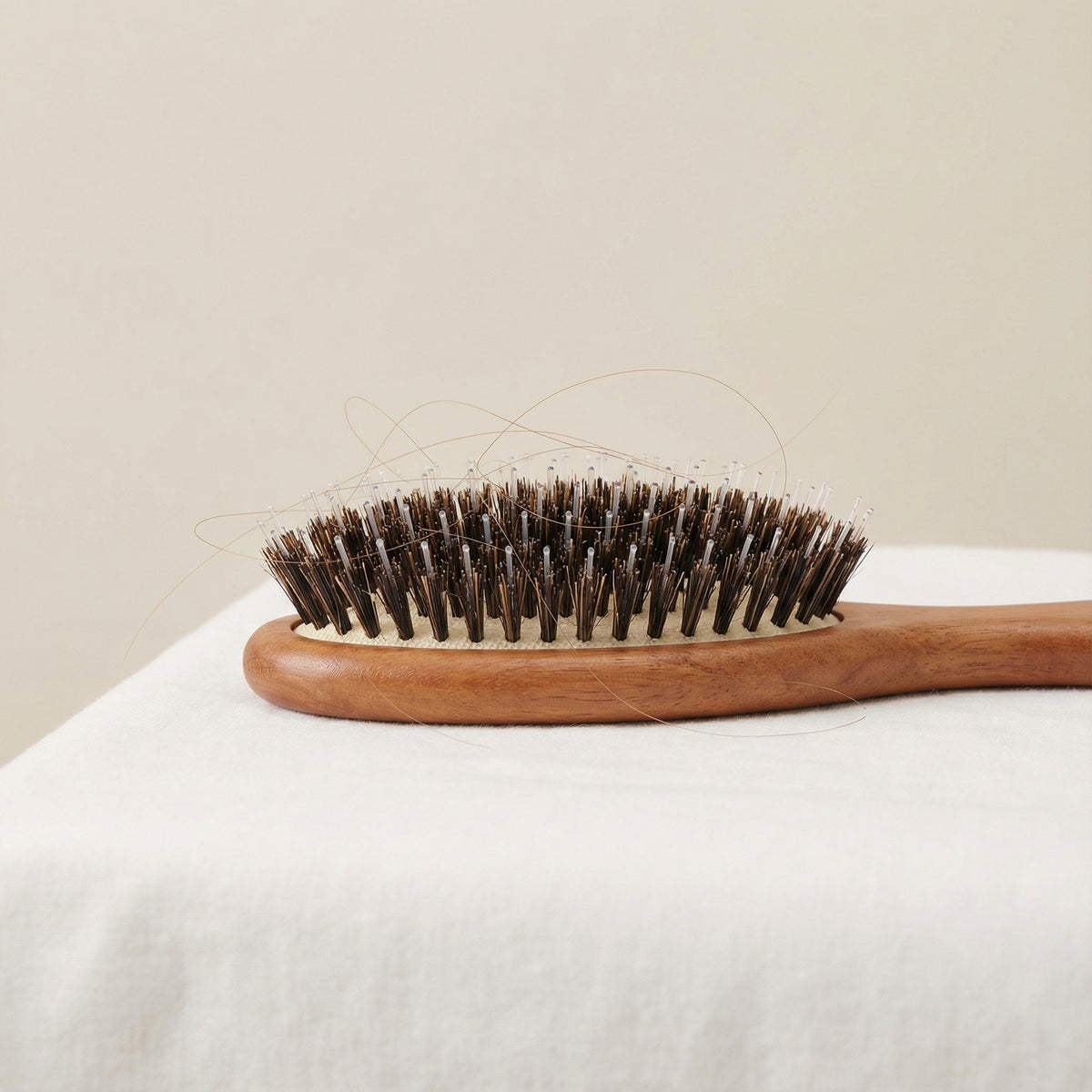
The leaves are falling. Cute. Your hair is falling too. Less cute. Suddenly there's more hair in your brush, more in the shower drain and a few strands on your favorite sweater.
Before you spiral: seasonal hair shedding is real, it's common, and in most cases it's temporary. Let me spill what's actually going on, how long it lasts and how to tell if it's just the season or something more.
Key Takeaways
- ✓Many people shed more hair in late summer and fall. It's a normal, temporary pattern.
- ✓The hairs falling now often stopped growing months earlier, in summer.
- ✓Seasonal shedding usually settles within a few weeks to about 3 months.
- ✓Shedding that lasts longer, comes in clumps or leaves a wider part needs a closer look.
- ✓A healthy scalp routine supports the new hairs that grow in next.
The short answer
Seasonal hair shedding is a normal, temporary increase in hair fall, most often in late summer and fall. More hairs enter the resting phase in summer and fall out a few months later. It usually settles within a few weeks to about 3 months. If it lasts longer, see a doctor.
Why Does Hair Shed More in Fall?
Quick refresher: every hair on your head has its own cycle. It grows (anagen), takes a short break (catagen), rests (telogen) and then falls out so a new hair can take its place. Losing about 50 to 100 hairs a day is normal.
Read nextHow Many Hairs Do You Lose a Day? What's Normal (and What's Not) →
1More hairs go into the resting phase in summer
Here's the tea. A study of healthy women found that the share of resting hairs was highest in summer, and the shedding followed in the months after. So the hair you lose in fall often "decided" to stop growing back in July.
2The summer sun theory
One popular explanation: in summer, your body may keep more hair to protect your scalp from the sun. When the days get shorter, those extra hairs aren't needed anymore and let go. It's a theory, not a proven fact, but it fits the timing.
3Summer stress on your hair and scalp
Sun, salt water, chlorine, heat and travel. Your hair had a busy summer. That doesn't cause root shedding by itself, but it can make your lengths dry and fragile, so you see more broken pieces in fall too.
4Life happens in fall too
Back-to-school stress, a busy work season, a cold or flu. Big stress or illness can trigger extra shedding about 2 to 3 months later. That's called telogen effluvium (fancy name, simple meaning: your hair took a stress break).
Read nextTelogen Effluvium: Why Stress Makes Your Hair Fall Out →
How Long Does Fall Hair Shedding Last?
For most people, seasonal shedding settles within a few weeks to about 3 months. The hairs that fall out are replaced by new ones that are already growing underneath.
That's the good part: shedding hair is not losing hair forever. If your follicles are healthy, they start a brand new growth phase.
Seasonal Shedding or Something More?
The plot twist: not every fall shed is the season's fault. Check these three things.
- The bulb test: look at a shed hair. A tiny white bulb at the end means it fell out from the root, which is normal shedding. No bulb and a ragged end means it broke. Here's how: The Hair Bulb Test.
- The part check: look at your part in daylight once a month. A part that stays the same width is a good sign. A part that keeps getting wider points to thinning, not just shedding.
- The timeline: think back 3 months. Was there a fever, a crash diet, a big stressful event or a new medication? Then it's probably not (only) the season.
Trichologist tip
I've had androgenetic alopecia and alopecia areata since I was young, so I know the fall panic when your brush suddenly looks fuller. In my consultation, I always ask what happened in your life 3 months before the shedding started. A season, a fever or a stressful month each point to a different plan, and the cause decides the treatment.
Read nextShedding vs. Thinning Hair: What's Actually Happening to Your Hair →
When to See a Doctor
See a doctor or dermatologist if the shedding lasts longer than 3 months, if hair comes out in clumps, if you see round bald patches, or if your part or hairline is clearly getting thinner. Also see a doctor if you feel very tired, cold or dizzy, or your periods have changed. Ask for blood tests for iron and ferritin, thyroid and vitamin D. A red, painful or scaly scalp should be checked quickly too.
How to Support Your Hair Through Shedding Season
You can't stop a normal seasonal shed, and you don't need to. What you can do is give the new hairs the best possible start, and keep the ones you have from breaking.
1Find Your Cause
The cause decides the treatment. Seasonal shedding needs patience and good scalp care. Shedding from stress, low iron or a hormone change needs that cause fixed first.
2Let's Activate the Hair Follicles
Give those follicles some love while they start a new cycle. Massage your scalp for 5 minutes a day and start deep oiling, which is my favorite treatment: scalp oil on your scalp, hair oil on your lengths, on for at least 4 hours before washing, or overnight.
Roll your clean scalp first with the Microneedle Scalp Roller (1 to 2 times a week, with 48 to 72 hours in between), then apply the Custom Hair Growth Treatment to your scalp and the Custom Hair Care Treatment to your lengths. Do it 2 to 3 times a week.

Why custom? Different causes need different ingredients. Shedding after a stressful season needs stress-relieving support, while thinning from genetics needs DHT blockers. I blend your formula to your cause.
Read nextWhat Is Deep Oiling Hair? My Favorite Hair Treatment, Explained →
3Keep Your Scalp Clean and Calm
Shed hairs, oil and dry winter air can leave your scalp itchy. Wash with a Custom Shampoo made for your scalp type (condition). Put some in your hand with a little water and emulsify it, so it spreads better on your scalp while you massage it in. Yes, you'll see hairs in the drain. Those hairs were already resting, so washing doesn't make you lose more.

Afsennah pick
Custom Shampoo
Made for your scalp type. Free from sulfates, parabens, silicones and alcohols.
Shop now4Be Gentle With Wet Hair
Use the Custom Conditioner on your lengths, detangle from the ends up and squeeze your hair dry with the Microfiber Towel Set instead of rubbing. Less breakage means less hair in your brush that you can actually prevent.

5Skip Tight Styles
Tight ponytails and buns pull on hairs that are already about to let go. Use the Silk Scrunchies Set and loose styles this season.
6Eat for Your Hair
Your hair is not essential to survival, so it's the first place your body saves on. Eat enough protein, and get your iron checked if you shed a lot.
7Be Patient
New hairs grow about 1 cm a month. First improvements from a scalp routine usually show after 8 to 12 weeks, with more visible results after 3 to 6 months.
The Best Afsennah Products for Seasonal Shedding

Custom Hair Growth Treatment
The pre-wash scalp oil, blended to the cause of your shedding.
Shop now

Frequently Asked Questions
Is seasonal hair shedding normal?
Yes. Many people shed more in late summer and fall. It's temporary, and the hairs are replaced by new ones.
What months does hair shed the most?
Most people notice it in late summer and fall, around August to November. Everyone's timing is a little different.
How long does fall hair shedding last?
Usually a few weeks to about 3 months. If it lasts longer, or your part gets wider, see a doctor to check for other causes.
Does seasonal shedding happen to men too?
Yes. Men can shed more in fall as well. If a man also notices a receding hairline or a thinner crown, that's usually not seasonal and is worth checking.
“The cause decides the treatment.”
Afsennah, Certified Advanced Trichologist
The Takeaway
Seasonal hair shedding is a phase, not a forever. Give your scalp some extra love now, and the hairs growing in next will thank you.
Ready to start? Order your Custom Hair Growth Treatment or the Hair Growth Set, fill in the consultation you receive by email, and I'll blend your formula for your cause. It comes with my 180-day guarantee.
Lots of love,
Afsennah
And don't forget to follow me for more hair tips
More From Afsennah
About the author
Afsennah, Certified Advanced Trichologist
Afsennah is a Certified Advanced Trichologist and the founder of Afsennah, a custom haircare brand. After dealing with androgenetic alopecia, alopecia areata and scalp eczema from a young age, she began studying the scalp and ingredients to understand her own hair. Read her story.
This article is for general education and does not replace medical advice.


